Education in Pittville: Preparatory Schools in Pittville Circus Road
Mark Penfold
Introduction
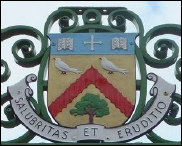 “Salubritas et eruditio”: Cheltenham’s motto and coat of arms make reference to learning, an important factor in the growth of the town. Cheltenham College, the Ladies’ College and Dean Close School are amongst the town’s best-known institutions. But what contribution did Pittville make to the educational life of Cheltenham in the 19th century?
Berkhampstead School, founded in 1945, has been providing education locally for over seventy years but was not the first school in the area to do so. This article provides a brief overview of the preparatory schools that were established in Pittville Circus Road in the second half of the 19th and early 20th centuries.
Pittville Circus Road Boarding Schools
Pittville Circus lies on the eastern boundary of the Pittville Estate and was laid out in 1839-40 by Edward Cope, a local builder, on land acquired from Joseph Pitt. Subsequently, Pittville Circus Road was constructed, linking the Circus to All Saints Road and to the Hewletts. A number of large Victorian mansions with extensive grounds were built along Pittville Circus Road from the 1840s onwards, many of them originally as private residences, but they were later to prove suitable premises for the establishment of private boarding schools, starting in the early 1860s, including:
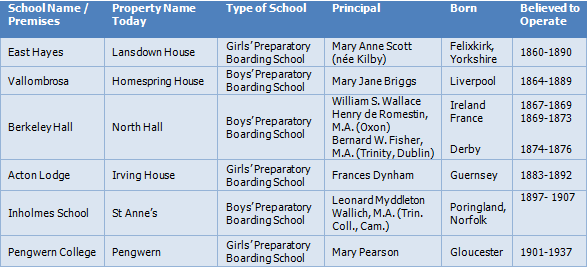
Private Schools in Context
In the 19th century, there were a large number of small private schools in Cheltenham. There was no effective regulation of schools and there were no legal requirements in respect of teacher training and qualifications. Educational standards varied considerably, and some schools closed after a few years of operation.
The number of small private schools would begin to reduce following the passing of the Elementary Education Acts from 1870. A national system of state education would introduce compulsory attendance for children up to ten years of age in England and Wales (1880), free elementary schooling in board and voluntary schools (1891) and would gradually lead to larger and better-equipped schools.
In Pittville, however, some small private schools operated quite successfully for many years, establishing themselves in Pittville Circus Road, attracted by the ample accommodation and spacious grounds offered by the properties there. Many of these schools were existing schools that moved to Pittville Circus Road from elsewhere in Cheltenham or from outside the town, although some new schools were also opened there. All of them were boarding schools but some advertised for day pupils as well. They had very broad catchment areas drawing pupils from across the country and overseas. Class sizes were small by today’s standards.
The boys’ preparatory schools were geared to preparing students for admission to English public schools, particularly Cheltenham College, and from there to university, as well as for admission to military academies such as Sandhurst and Woolwich. Some students went on to careers in the British establishment, in the civil and military, notably in the Indian subcontinent, and in commerce.
The girls’ preparatory schools were geared to providing an education for later life in the Victorian era. University education for women, on an equal basis as for men, was at that time unattainable. Oxford and Cambridge Universities required applicants to be male, single and members of the Church of England, in order to admit them.
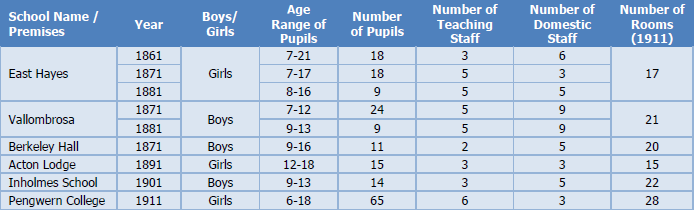
Note: Number of pupils excludes relatives of school principal and any day students;
number of teaching staff and number domestic staff will exclude any people who did not live at the premises
The principals of these schools hailed from outside the town, with not a Cheltonian amongst them, although some did become long-term Pittville residents. Similarly, nearly all the tutors and governesses, as well as most of the pupils, were from outside Cheltenham. People from Gloucestershire accounted for a fairly large proportion of the domestic staff.
The schools in Pittville Circus Road acquired a good reputation, providing an education to the sons and daughters of wealthy gentleman, many with Indian connections, who could afford the fees.
East Hayes
| Type of school: | Girls’ Preparatory Boarding School |
| Principal: | Mary Anne Scott, née Kilby (born Felixkirk, Yorkshire) |
| Period of operation: | 1860 – 90 (approx.) |
| Current property name: | Lansdown House |
| Link to large-scale OS map (1884): | East Hayes (north side of Circus Road, towards eastern end) |

The first school to be established in Pittville Circus Road was at East Hayes, where Mary Anne Scott opened a preparatory boarding school for girls around 1860. East Hayes, a fine mansion towards the eastern end of Pittville Circus Road, had been built by Edward Cope during the 1840s for Reverend John Browne, LLB, the curate of Trinity Church and Vice President of Cheltenham College, following a public subscription. It had been the first house to be completed along the road.
George Rowe, in his Illustrated Cheltenham Guide of 1845, sketched East Hayes, writing:
“The house is a plain but handsome erection, and when the plantations around it are advanced to maturity, and similar mansions erected on the adjacent plots of building ground, this, as an extension of Pittville to the eastward, will become a most desirable site for genteel residences.”
The property appears to be fundamentally unchanged today, nearly 175 years later.
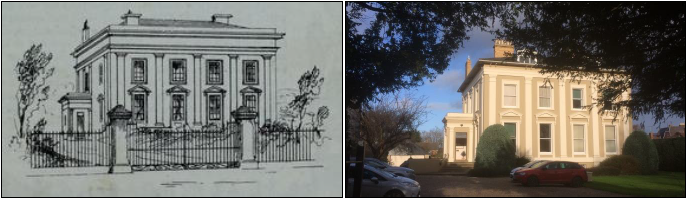
East Hayes, 1845 (George Rowe) Lansdown House, 2018
Mary Ann Scott was the daughter of Reverend Thomas Kilby and the widow of Henry E. Scott, a civil engineer. She ran her school at East Hayes for thirty years, competing with other local schools including Cheltenham Ladies’ College. Her girls achieved academic success as candidates in the Oxford local examinations.
While a boarding school, East Hayes was the birth place in 1885 of a notable grandson of Mrs Scott, Captain Arthur Kilby. During the First World War, Captain Kilby was awarded the Military Cross for his actions at Ypres in 1914 and the Victoria Cross for bravery in action on the first day of the Battle of Loos in 1915.
After the school closed, Mrs Scott continued to live at East Hayes for part of the 1890s until her death in 1897. Her son, Laurence Scott, an artist who exhibited on a number of occasions at the Royal Academy and the Royal Institution, lived with her. He gave painting and drawing classes at East Hayes and also exhibited there.
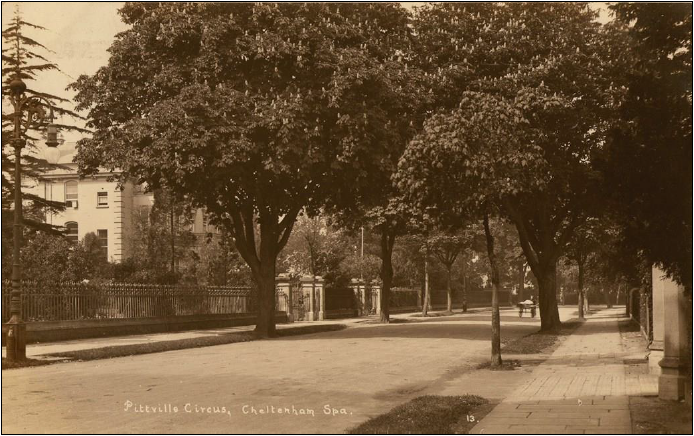
Pittville Circus Road, c1923, looking east towards East Hayes and Vallombrosa (Pittville History Works)
Vallombrosa
| Type of school: | Boys’ Preparatory Boarding School |
| Principal: | Mary Jane Briggs (born Liverpool) |
| Period of operation: | 1864 – 89 |
| Current property name: | Homespring House |
| Link to large-scale OS map (1884): | Vallombrosa (north side of Circus Road, towards eastern end) |

Like East Hayes, the neighbouring Vallombrosa was a fine, large mansion with extensive grounds built during the 1840s. From 1854-58 it was the residence of General Sir James Archibald Hope, GCB, a decorated army officer who had been with Wellington in Spain during the Peninsular War. Around 1858, he moved to the newly built Balgowan House nearby on Pittville Circus Road (now demolished and replaced with the block of flats that is Fairhavens Court), where he died in 1871.
In 1864, Mary Jane Briggs opened her preparatory boarding school for boys at Vallombrosa, although she had actually founded the school some fifteen years earlier in the Lansdown area of Cheltenham. She ran the school in Pittville Circus Road for twenty-five years, acquiring a very good reputation, particularly at Cheltenham College. A number of her pupils were awarded scholarships to English public schools, military academies and universities.
You can read more about Mary Jane Briggs in the accompanying article on the Pittville History Works website.
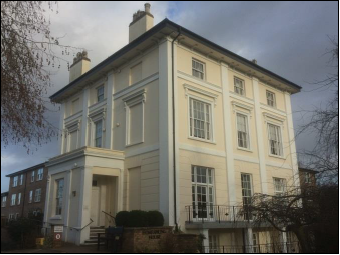
Vallombrosa (now Homespring House), 2018
Berkeley Hall
| Type of school: | Boys’ Preparatory Boarding School |
| Principals: | William S. Wallace (1867-69) b. Ireland |
| Rev. Henry de Romestin, M.A. (Oxon) (1869-73) b. France | |
| Bernard W. Fisher, M.A. (Trinity, Dublin) (1874-76) b. Derby | |
| Period of operation: | 1867 – 76 |
| Current property name: | North Hall |
| Link to large-scale OS map (1884): | Berkeley Hall (south side of Circus Road, at its western end) |

East Hayes and Vallombrosa were situated on the north side of Pittville Circus Road. In fact, until the 1860s, all development had been to the north of the road. By the mid-1860s, residential development had commenced on the south side at its western end close to the site of All Saints Church. Berkeley Hall, known as North Hall today, was one of the first completed properties to be occupied.
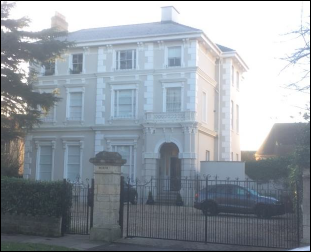
Berkeley Hall (now North Hall), 2018
William Samuel Wallace had established his preparatory school for boys in 1832 in his home at Berkeley Villa in Berkeley Street, Cheltenham, but chose to move a short distance in 1867 to the newly built premises in Pittville Circus Road which he named Berkeley Hall, possibly to give an idea of the ample accommodation (twenty rooms) and grounds.
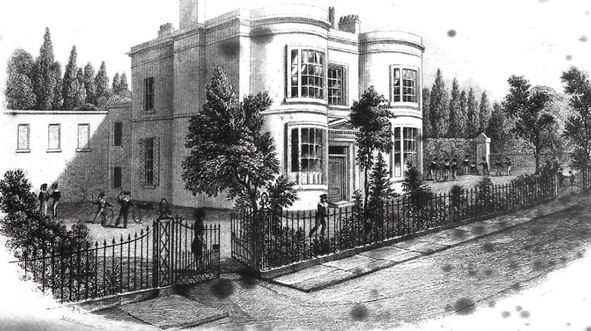
William Wallace’s earlier school at Berkeley Villa, Berkeley Street, Cheltenham
From: Berkeley Villa Scholar’s Manual (Cheltenham, 1848), frontispiece and foll. p. 128.
The book includes a listing of the contents of the school library
Courtesy of Cheltenham Local & Family History Library
By 1869, Reverend Henry de Romestin, M.A. (Oxon.), curate of St John’s Church (now demolished), had become the school principal, proudly advertising that he prepared the sons of gentlemen:
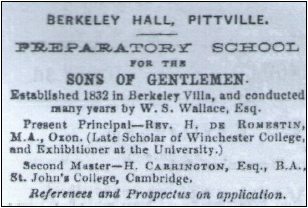
Cheltenham Looker-On, 30 October 1869
By 1874, the Reverend de Romestin had moved to Oxfordshire, becoming the incumbent of St Mary’s in Freeland. This gave Bernard W. Fisher, M.A. the opportunity to move from Malvern to Berkeley Hall in early 1874 in order to increase the size of his school (some nine pupils in 1871). He offered to prepare boys for Cheltenham College and other public schools, charging 80 to 100 guineas per annum or 60 guineas for juniors.
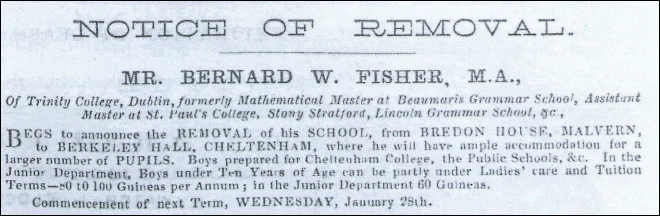
Cheltenham Looker-On, 10 January 1874
Bernard Fisher embarked on an intensive advertising campaign in local newspapers to attract business in what was a crowded, competitive and largely unregulated market place. The following advertisement from the Cheltenham Looker-On in August 1876 was typical:
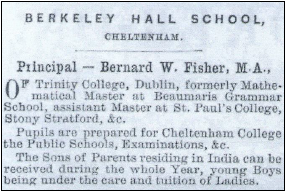
However, this did not appear to meet with success and in 1876 Bernard Fisher left Pittville Circus Road.
Berkeley Hall became the residence of the splendidly named Newman Burfoot Thoyts, a retired Indian Army Colonel, Alderman and Mayor of Cheltenham from 1888 to 1891.
Acton Lodge
| Type of school: | Girls’ Preparatory Boarding School |
| Principal: | Frances Dynham (born Guernsey) |
| Period of operation: | 1883 – 92 (approx.) |
| Current property name: | Irving House |
| Link to large-scale OS map (1884): | Acton Lodge (south side of Circus Road, towards western end) |

The Misses Dynham (two sisters, Frances and Alice) opened their boarding school at Acton Lodge around 1883, with Frances Dynham as principal, and for ten years educated the daughters of gentlemen, with an emphasis on foreign-language teaching.
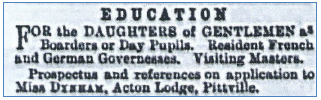
Cheltenham Looker-On, 15 September 1888
The property was located on the south side of Pittville Circus Road not far from Berkeley House. The school achieved some success at the College of Preceptors’ local examinations.
In the summer of 1892, the Misses Dynham moved to 2, Fauconberg Terrace in Cheltenham and Acton Lodge (now part of Irving House) reverted to a private residence.
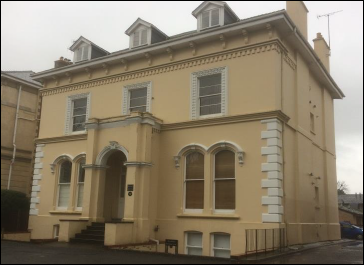
Acton Lodge (now part of Irving House), 2018
Inholmes School
| Type of school: | Boys’ Preparatory Boarding School |
| Principal: | Leonard M. Wallich, M.A. (Trin. Coll., Cam.) (b. Poringland, Norf.) |
| Period of operation: | 1897 – 1907 |
| Current property name: | St Anne’s |
| Link to large-scale OS map (1884): | Donore (south side of Pittville Circus Road, at its western end) |

In 1897, Leonard M. Wallich, M.A., the son of a vicar from Great Poringland, Norfolk, and a teacher with around twenty years’ experience, decided to relocate his school, Inholmes School, to Pittville from Burgess Hill, Sussex, owing to “insufficient accommodation”.
There was certainly sufficient accommodation at the premises he moved to, namely twenty-two rooms together with a large field of some six acres for games. He chose a property next to Berkeley Hall that had changed name several times, given its reputation, and may well have obtained favourable terms on the lease. Garden Reach had been the unhappy home of Henry Swinhoe and was reputed to be haunted. The name of the property was changed by each subsequent owner, first to Pittville Hall by Mr & Mrs Littlewood, then to Donore by Captain Despard, then again to Inholmes by Leonard Wallich.
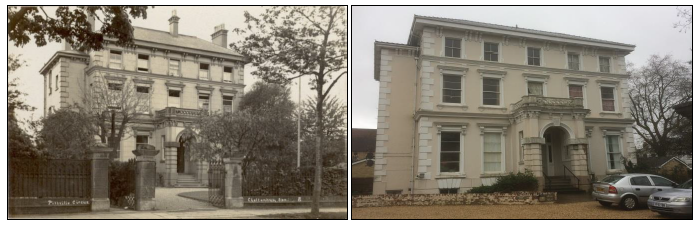
Former premises of Inholmes School, today St Anne’s, Pittville Circus Road, c1920s (Pittville History Works) and 2018
Advertisements taken out in local newspapers in 1897-8 show that Wallich prepared “the sons of gentlemen for public school scholarships, entrance examinations and the Royal Navy” and was “particularly successful with backward boys”. He also advertised for day pupils.
Advertised academic successes included three pupils passing the Cambridge University local examinations (junior), one with honours and one with distinction (December 1897), and another being awarded a scholarship to Lancing College (July 1898), although these probably related to his Sussex-based pupils.
The school in Pittville Circus Road closed after ten years in 1907, and the premises became an Ursuline Convent, retaining the name of Inholmes. Leonard Wallich moved to Watford with his family, becoming headmaster at Gisburne House School, but subsequently emigrated to Winnipeg, Canada, where he set up another preparatory school. He died in Canada in 1918.
Pengwern College
| Type of school: | Girls’ Preparatory Boarding School |
| Principal: | Mary Pearson (born Gloucester) |
| Period of operation: | 1901 – 37 |
| Current property name: | Pengwern |
| Link to large-scale OS map (1884): | Pengwern (next to Sunnyside, diagonally opposite Vallombrosa) |

Pengwern School was founded by Mary Pearson on the site of St Anne’s Promenade in Albion Street but moved to large, newly built premises (twenty-eight rooms) in Pittville Circus Road in 1901. The name change to Pengwern College appears to date from the time of the move to the new site. It is situated towards the eastern end of the road, on the south side. Its principal was Gloucester-born Mary Pearson and under her direction it became a relatively large school, with sixty-five girls boarding there by 1911.
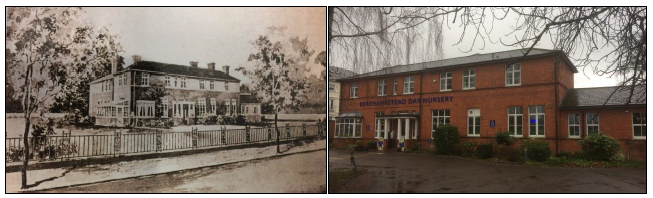
Pengwern College, past and present (1901 and 2018)
Pengwern placed emphasis on physical culture in the curriculum and the college was probably best known amongst residents of Cheltenham for its athletic displays, which took place from 1901 to 1934, originally in the Winter Gardens and subsequently in the Town Hall, reportedly drawing full houses. Reginald Pearson, Mary’s husband and College Tutor, coordinated these displays. He was a well-known sportsman, having played rugby in his native Liverpool and then for Gloucester, subsequently captaining Cheltenham in 1895
The Gloucestershire Echo described the displays thus:
”They were remarkable for their complexity, many of the exercises being nothing short of mass juggling feats in which skipping-ropes, ranges, balls, hoops and plates were used to demonstrate co-ordination of mind and body. Many of the exercises took place to the music of well-known military bands.” (16 February 1937)
The much-decorated Major-General Sir John Duncan, K.C.B., C.M.G., D.S.O., after seeing the 1929 display, enthused:
”I have seen military displays at Olympia and at many military tattoos and tournaments, but I have never seen one to surpass this in skill, precision and rhythm.” (16 February 1937)
Photographs of the displays were published nationally and internationally, leading to girls from as far afield as Russia, the United States, South America and Africa attending Pengwern. The displays also raised money for local charities and institutions, reportedly amounting to some £1,500 in total.
You can view a Pengwern College display from 1930 entitled “Slick Drill” in this Pathé Newsreel clip.
Pengwern was a long-standing school, operating for over thirty-five years in Pittville Circus Road by the time it closed in 1937. The Pearsons decided to retire to Ilfracombe, the pupils were transferred to other schools and the premises were sold by auction.
During the Second World War, Pengwern was a maternity hospital, and the actor Martin Jarvis was born there in 1941.
Berkhampstead School
In 1945, at the end of the war, Berkhampstead School was established by Edna Andrews in her home (‘Berkhampstead’), continuing the provision of education locally. The school subsequently expanded into Fernbank, a Grade-2 listed building on the south side of Pittville Circus Road. It opened with twenty-two pupils, with boys aged from three to eleven and girls aged from three to eighteen. Fees were £5 per term.
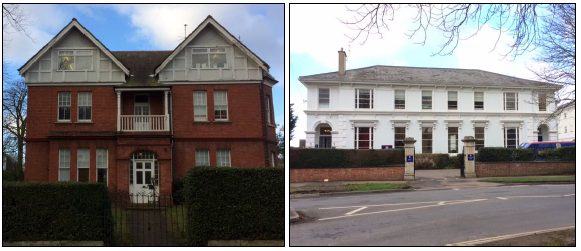
Berkhampstead and Fernbank, 2018
More recently Berkhampstead School, which has been operating for over seventy years, acquired Pengwern for its day nursery. Today, the school has approximately 275 pupils, boys and girls, aged three to eleven in the main school (which comprises prep and pre-prep schools) and over 100 in the day nursery. Pupils go on to many well-known educational institutions, including local schools such as Cheltenham College, Dean Close, Pate’s, St Edward’s and King’s School in Gloucester.
In conclusion, the education system has clearly changed enormously since the Victorian era. The single-sex boarding schools along Pittville Circus Road have long since disappeared and, with them, the Victorian educational ethos. Today, an independent, co-educational school educates day pupils based on a different, modern ethos. Nevertheless, there has been an almost unbroken run of private schools offering preparatory education in Pittville Circus Road from the 1860s, and that tradition remains alive today.
February 2018
Sources
Ancestry; Cheltenham Annuaires & Directories; Cheltenham College; British Newspaper Archive; Berkhampstead School website; BBC Gloucestershire; Wikipedia; other information in the public domain available through the World Wide Web
The assistance of Cheltenham Library with this article is gratefully acknowledged.