Educational establishments in Pittville 1870-1950, excluding Pittville Circus Road
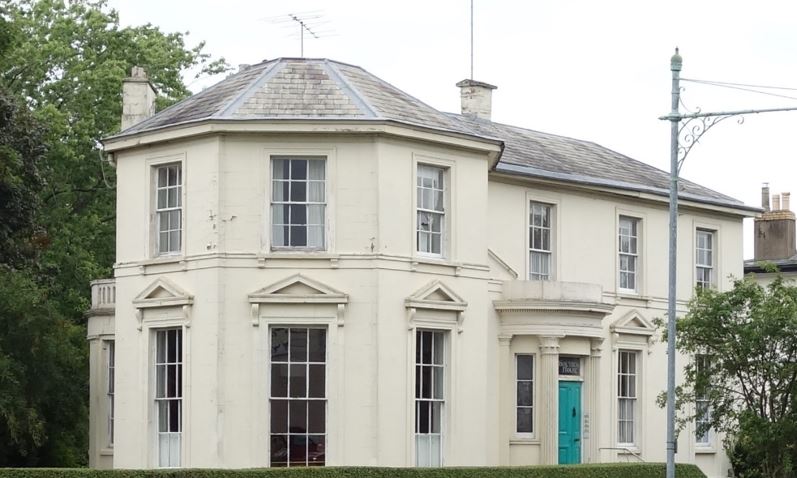
Southend House, Prestbury Road, the site of one of establishments called
The Pittville Preparatory School
The transcription of census returns carried out by the Pittville History Works group shows that several schools were in operation in Pittville during the period 1870-1950. Mark Penfold has identified schools that were established in Pittville Circus Road in the late nineteenth and early twentieth century; this article identifies some of those uncovered by further research elsewhere in Pittville.
Many of the large buildings on the Pittville estate had originally housed one well-to-do family, but changes to society beginning in the late nineteenth century brought a broader range of residents to Pittville. Household sizes became smaller and some of the larger houses were broken up for multiple occupation whilst others found new uses as schools. Some of these educational establishments seem to have consisted of just a few pupils in what was in effect a private house, two different establishments had the same name, and one became the girls’ grammar school for the town. Although the 1870 Education Act enabled elementary education for all children, rich or poor, boy or girl, the schools that emerged in Pittville around that time would have been private, fee-paying establishments.
The history of these schools is discussed in further detail below.
- Pittville Preparatory School, Wellington Square (1854-8)
The earlier of the two schools founded with the same name, Pittville Preparatory School was sited in Wellington Square in the house then known as The Aviary (now the site of Cranley Lodge). Miss E. Hadley (‘from Derby’) advertised the opening of her new school in February 1854 for boys (sons of ‘Gentlemen and Professional Men’) up to the age of eight, under the direction of the Headmaster of the Grammar School. Latin and Arithmetic were to be taught, along with French, Drawing, and Vocal Music, though the teacher for Calisthenics (a form of strength training) had yet to be appointed. The school opened on 1 February 1854, and younger pupils were to be taught on the Scotch ‘Gallery’ system. Boarders were charged 35 guineas a year (with an extra two guineas added for ‘Washing’), whereas day boarders were charged £20 a year; day pupils under the age of six paid six guineas, and those above the age of six paid eight guineas. In general, Miss Hadley offered dancing and French each at an extra two guineas a year. Looking ahead to later educational facilities, ‘an omnibus has been engaged to convey all the younger Children to and from School, without extra charge’ (Cheltenham Chronicle, 12 January).
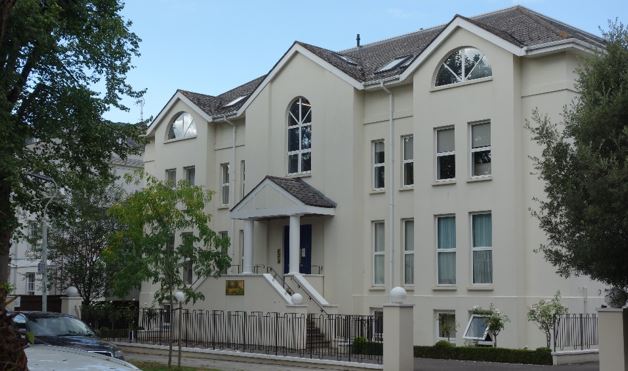
Cranley Lodge, on the site of the short-lived Pittville Preparatory School
in Wellington Square, in the house known as The Aviary.
In September of that year the Revd. Samuel Curtis Sharpe (of Christ’s College, Cambridge) announced that he was taking over the management of the preparatory school. The school was now to provide the education of boys up to the age of fourteen, both boarders and day pupils. Pupils with parents in India would be received ‘for the whole year’, staying there during the holidays if they had no suitable relatives or guardians in the country. The Revd Sharpe taught the senior boys in subjects such as Latin and Mathematics, while his wife Maria (née Palmer) ran the Junior department (though she died in 1855), employing Miss Hadley to coordinate the teaching. There was accommodation for boarders.
Samuel Sharpe claimed in his advertisement to have ‘thirteen years’ experience in Private Tuition’, and it seemed as if the school, with its support from the long-established Grammar School nearby in the High Street, was expanding. But it turned out that Sharpe was involved in a long series of frauds, both in Britain and abroad. He remained at the school until 1858. But in 1866 his past caught up with him, and he was declared bankrupt, and soon left the country for France and Ireland to avoid the attentions of the English police; he died at Carnoustie, Angus in 1868. While the Grammar School has continued to this day, this Pittville Preparatory School was short-lived, and was no longer running in 1859.
- Laurel Lodge School (1835-6)
Next to The Aviary is Laurel Lodge, which was the site of a school established by Mrs Mary Mechelen in 1835, and intended as a boarding school for twelve girls. Mrs Mechelen had previously run similar establishments in Bath and then Bristol, but her husband Joseph (also Josiah) was being sued for bankruptcy in 1835, and the finances of the school were unstable. Mrs Mechelen could not meet her rent of £170 per annum and the school moved next year to Sussex House, Winchcombe Street, before the unfortunate Mechelens left Cheltenham in the late 1830s.
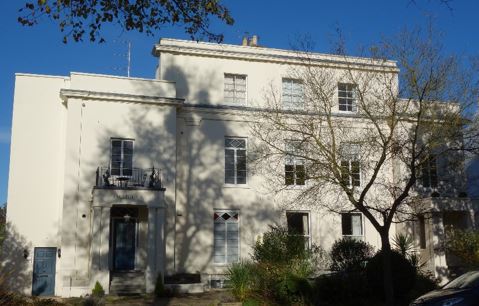
Laurel Lodge, on the left, where the Mechelens planned
a boarding school for girls.
- Pittville Preparatory School, Southend House, Prestbury Road (1890-1921)
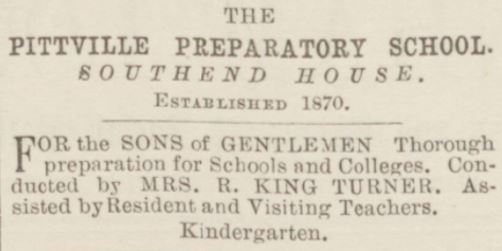
The Cheltenham Looker-On, 11 March 1899
The later of the two establishments called Pittville Preparatory School was situated at Southend House, now 32 Prestbury Road. The school had been established in 1870 at Gapton House (which no longer exists), opposite Holy Trinity Church in Portland Street, to provide kindergarten and preparatory education ‘for the Sons of Gentlemen’. The driving force behind the school was Sarah King-Turner (her husband’s occupations varied, from ‘Dealer’, to ‘Hardwareman’ to School Attendance Officer). In September 1890, as Principal, she announced that the school was ‘removing’ to Southend House and that she was extending her preparatory school, now for boys only, who would be prepared for the Public Schools. There was to be accommodation for boarders, and she would be assisted by certificated Assistants and Masters. At the time of the 1891 and 1901 censuses there were no boarders listed as living at the school on census night. In 1911 there were five boarders, one woman aged twenty-four from Lancashire, and four boys aged between 6 and 15, from Gloucestershire and surrounding counties.
From time to time the local papers noted examination successes by Mrs King-Turner’s pupils, at first in the College of Preceptors’ exams: in 1896 her son Harry, a pupil of the Pittville Preparatory School, passed his exams in the 1st Division for his year (the Third Class), and in the following year, he remained in the 1st Division when he took his exams in the Second Class (it was noted that his marks entitled him to register as a medical student, should he want to). In 1892 Arthur Rae, who lived at Berkeley house (now 25 Pittville Lawn), was adjudged in the 2nd Division of the Third Class and in the following year Cecil Manners, born in the East Indies and living with his grandmother at 16 Wellington Square, achieved marks in the 1st Division of the Third Class. By 1902 George M. Paterson passed his piano examination in the Trinity College London musical examinations.
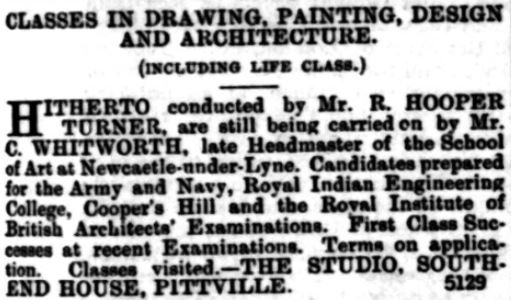
Advertisement announcing Robert Turner’s replacement as art teacher
at Southend House (Cheltenham Examiner, 25 November 1903)
By 1903 pupils also attended classes in drawing, painting, design and architecture (including a life class), held in ‘The Studio’ at Southend House. They took exams for entrance into the Army and the Navy, the Royal Indian Engineering College at Cooper’s Hill in Surrey, and RIBA Examinations. These classes, presumably for students older than the preparatory school pupils, were given by one of the six children of the King-Turners, Robert Hooper Turner. Robert died in the autumn of 1903, but he was fairly swiftly replaced by a Charles Henry Whitworth, formerly head of the School of Art, Newcastle-under-Lyme. Whitworth lived over the road, in 1905 moving to 3 Selkirk Parade (now 67 Prestbury Road), where he also taught in his studio there, and then to 6 Selkirk Parade (now 61 Prestbury Road) in 1913, where he is recorded in 1933. Another King-Turner son, Andrew, born in about 1872, became a doctor and ran The Retreat, an asylum in Fairford, Gloucestershire. Daughter Ellen was a music teacher, and Agnes taught at the school in Southend House, taking over as Principal when her mother died in 1909. The latest appearance so far traced of the school is in the electoral register of 1921.
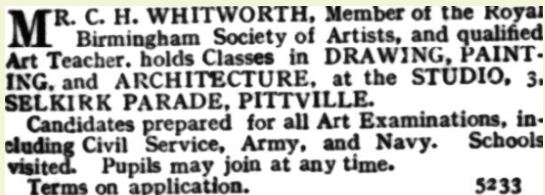
Charles Whitworth’s advertisement for art classes at 3 Selkirk Parade
(Cheltenham Examiner, 1 August 1906)
- Ravenhurst, Pittville Lawn
Ravenhurst, on Pittville Lawn, was the site of a nursery in the late 1930s and 1940s. The school appears variously as a nursery ‘home’, fostering up to ten babies and small children, and a nursery ‘school’, offering a class. It was run by a Miss Diana Burmester, who had been born in Hertfordshire but by 1936 was living in Cheltenham. The nursery seems to have been established at Glenrise on Harp Hill, Miss Burmester’s home at the time, moving to the Pittville Lawn site in October 1936, when she advertised a new morning class for ‘a few young children’. In 1937 she made a successful application as a foster mother to care for up to ten infants.
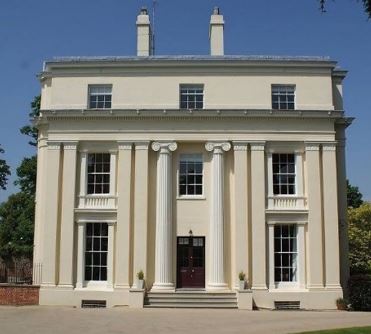
Ravenhurst on Pittville Lawn, the site of a nursery school
in the 1930s and 1940s
In December 1941 a 10-week-old baby died at the home – he had been in the home since he was about two weeks old. His father was a captain serving in the Middle East, and while today we might wonder at such a young child being boarded out, the inquest concluded that there was no suggestion of negligence. A later incident occurred with a 5-year-old girl – a weekly boarder from Berrow, near Malvern – fracturing her elbow in a fall down the front steps. Again, the court found no negligence on the part of the nursery, remarking that ‘accidents happened in the best regulated schools’.
Between 1936 and 1945 there were several advertisements for staff – either the business was expanding or staff tended not to stay long. The school seems still to have been active in 1944, when Miss Burmester was fined for failing to observe the wartime blackout regulations (several years earlier she had been fined for leaving her vehicle so as to cause an obstruction in the Colonnade – between Boots Corner and Martins Jewellers), but in November 1945 a successful planning application was made to Cheltenham Borough Council to convert Ravenhurst into flats. The electoral register of 1946 shows at least four households there, so it appears that the school had closed by then. Miss Burmester died in Hastings in 1995, aged 87.
- Godwynhurst School, Pittville Lawn
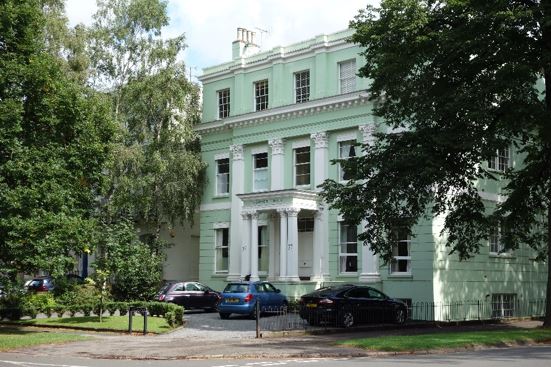
Kenilworth on Pittville Lawn, once the site of Godwynhurst School
There are several instances of schools moving to new premises over time and changing their name in the process. Just as Ravenhurst nursery may have moved from a site outside Pittville, Godwynhurst School was formerly Overton House School, in St George’s Road. There was a Godwynhurst College in Dover, but no link has been established between the two schools. In May 1944 Godwynhurst moved to temporary premises at ‘Gateway’ in the town, and in 1947 it appears in Kenilworth, Pittville Lawn.
During the 1920s the school was a day- and boarding-school for girls up to the age of nineteen; by 1928 it served as a preparatory school for boys as well. In 1941 ‘a completely new regime’ was announced, with the school now under a ‘well-known educationalist’, Mrs Hugh Maclean. The youngest pupils would be taught using the Froebel system, learning through experience and play. The advertisement somewhat archly warns off parents who only want large classes and mass-production. This school will only cater for the children of the professional classes! The advertisement of July 1943 mentions a ‘Seaside Summer House’.
Schools in the town often had to use games pitches and playing fields at some distance. An application was recorded in the Borough Council minutes of 13 February 1939 for the use of St Mark’s hockey pitch by Overton House School. The girls of the Grammar School also had to walk to Battledown for their games pitches while their school was at St Margaret’s Road.
Most of the newspaper cuttings available relate to the school’s artistic achievements, in Royal Drawing Society exams, music exams and the local competitive music and drama festival, but there is a cutting reporting examination success in standard subjects. There are former pupils in Cheltenham, boys and girls, of the school reminiscing on the Facebook site Days Gone By in Cheltenham; in the annual Schools of England, Wales, Scotland, and Ireland of 1957 it is listed as ‘Co-ed. Pre-prep. Day.’
- Miss Humpleby’s Preparatory Establishment for Young Gentlemen, 4 Selkirk Parade (now 65 Prestbury Road)
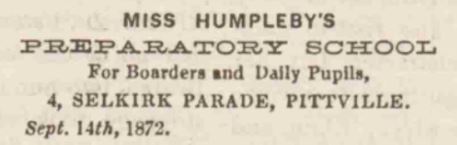
By 1872 Miss Humpleby had moved to Selkirk Parade.
Cheltenham Looker-On, 14 September 1872
Schools advertised in smaller properties might have been an informal arrangement whereby the lady of the house offered accommodation to children whose parents were abroad, or at least not living locally. An advertisement appeared in July 1860 for ‘Miss Humpleby’s Establishment for Young Gentlemen’ at 2 Sussex Villas (now part of the terrace in Clarence Road). It was still there in 1863, but by 1865 Miss Humpleby was a tenant of 4 Selkirk Parade, where the school was based until at least 1872. It is difficult to imagine how everyone was accommodated in a house of this size, with some space necessarily given over to at least one classroom.
Although the school was advertised for boys, an advertisement in 1872 for the ‘Preparatory School for Boarders and Daily Pupils’ suggests its range was broadening, and in 1871 the other boarding residents were Mary Teague, and Emily and Francis Chapman, aged 12, 6, and 5 respectively. Mary Teague, who came from the Forest of Dean, may well have been a pupil-teacher, helping with the younger pupils, later becoming a governess to the daughters of a farming family near Droitwich. Emily and Francis Chapman were from a well-known local family who had been near neighbours of Mary Humpleby in Sussex Villas. In the 1860s the family moved to the detached Oaklands, a large house further up Prestbury Road, with outbuildings, stabling, and an orchard. (The house still stands, set back from Prestbury Road, now obscured from view by the houses since built on Oaklands’ land.) In October 1869 their mother (by then ‘well-known in the country’) was returning from seeing their father off at the station when she was thrown out of her carriage in Winchcombe Street – seriously, though not fatally, injured. Robert Chapman was a dealer in horses for the gentry and would travel to race meetings across the country. At the wedding of Emily’s elder sister, at St Mary’s Prestbury on New Year’s Eve 1879, guests included the local MP James Agg-Gardner, the Duke and Duchess of Beaufort and Lord and Lady Fitzhardinge. Francis Chapman later went into the Army. (For more information on the Chapmans, see ‘Mary Chapman’ at Retirement from the East Indies - in Pittville on this site.)
In 1878 Miss Humpleby moved along the terrace to No. 11 (now 51 Prestbury Road). In 1881 her occupation is still listed as Instructress, so maybe she was still running her school. The last known entry for her at this address falls in 1885, by which time she would be about sixty-five, presumably in retirement. In 1881 the occupants of No. 4 were Emma Lailey, living on her ‘own means’, and her daughter Elizabeth. In 1891 Miss Humpleby was living with her nephew in Camberwell, where she died in 1906.
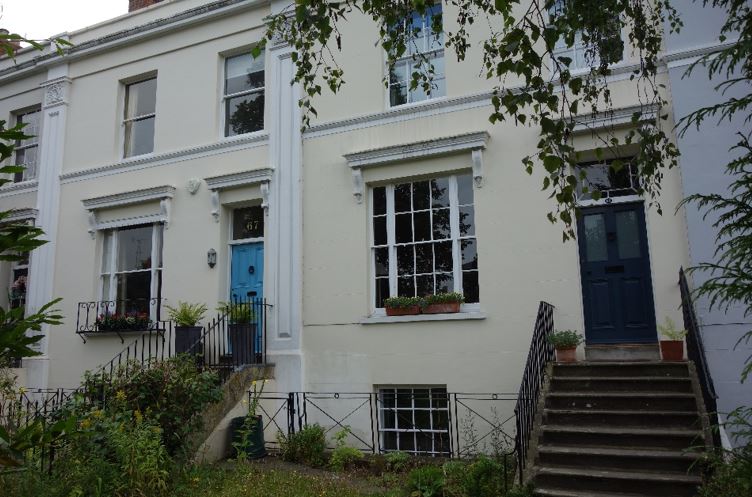
4 Selkirk Parade, where Miss Humpleby ran her Preparatory School. To the left is No. 3,
sometime residence of Charles Whitworth, art tutor at Pittville Preparatory School
at Southend House just down the road.
- Pate’s Grammar School for Girls
In 1990 a former pupil of ‘Cheltenham’s Other Girls’ School’, Barbara King, published a booklet* to capture the history of Pate’s Grammar School for Girls and preserve the account of the Girls’ School as a separate entity, before it merged with Cheltenham Grammar School under the Pate’s Foundation.
The foundation stone for the new building to house Pate’s Grammar School for Girls was laid at the new site in Albert Road on 23 July 1938. This ceremony marked the end of several years of campaigning for a larger site to accommodate the pupils. The school had been founded in 1905 (231 years after the boys’ school), and until 1939 was housed in Livorno Lodge on the corner of North Street and St Margaret’s Road. In 1926 the Chairman of the Governors had emphasised new plans for the school – a separate playing field and a new school building. In the school’s first years the girls had to walk to the playing field at Battledown for games. The new playing field was behind Wellington Square and came into use in 1927.
In early September 1939 volunteers moved everything up the road to the new school, but it was still unfinished when the Autumn Term began – and war had just broken out. Girls from King Edward’s High School Birmingham had been evacuated to Cheltenham for safety, so a time-share system operated, with the Cheltenham girls using the building in the morning and the Birmingham girls in the afternoon. Various improvements were added over the years – glass was put in the walkways (many former pupils have memories of snow and rain blowing in), a swimming pool was built, and a domestic science block. In 1986 the girls’ and boys’ schools merged and became Pate’s Grammar School on the site then occupied by the boys’ school in Princess Elizabeth Way. The Albert Road building is now the site of Pittville School, a mixed comprehensive for 11- to 16-year-olds. (See also Pate’s Girls Grammar School at John Simpson’s ‘A gazetteer of Pittville house names in the 19th and early 20th centuries’ on this site.
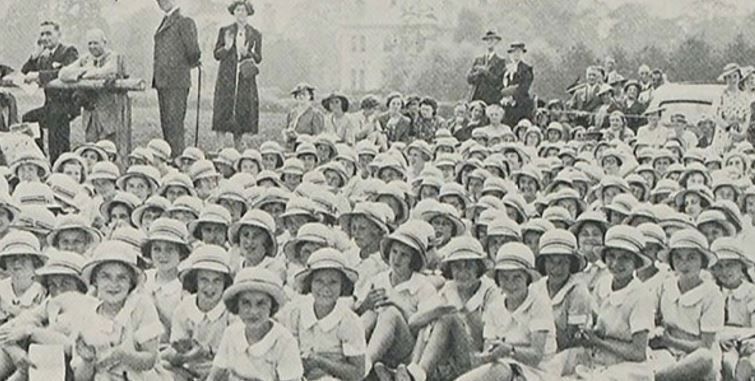
PGSG girls at the foundation stone ceremony, Albert Road, July 1938
The Cheltenham Chronicle and Gloucester Graphic
- Pittville School of Dancing (Lister Dance School)
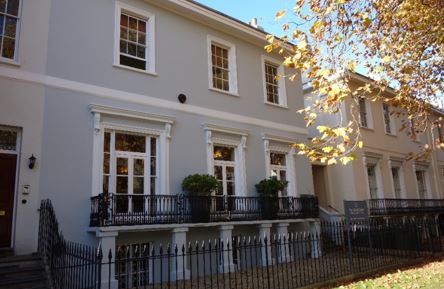
Montague Villa, now 6 Pittville Lawn, once the site of
the Pittville School of Dancing
The Pittville School of Dancing was located at Montagu Villa, now 6 Pittville Lawn, and offered classes for both children and adults, and at several levels. The school started in 1943, offering ‘all that is best in dancing’. There were lessons mainly in ballet, but also in tap- and ballroom-dancing. As the illustration shows, there were also fencing classes under the instructor Margaret Marsh – fencing was considered good for posture – and a physical culture class for ladies on Monday evenings. The importance of being able to dance is illustrated in several of their many advertisements which read ‘Dancing is such a social asset’. In addition to ‘Strict beginners’ courses’, in October 1950 the school was also offering classes for married couples so that earlier skills were not lost once one had caught a partner!
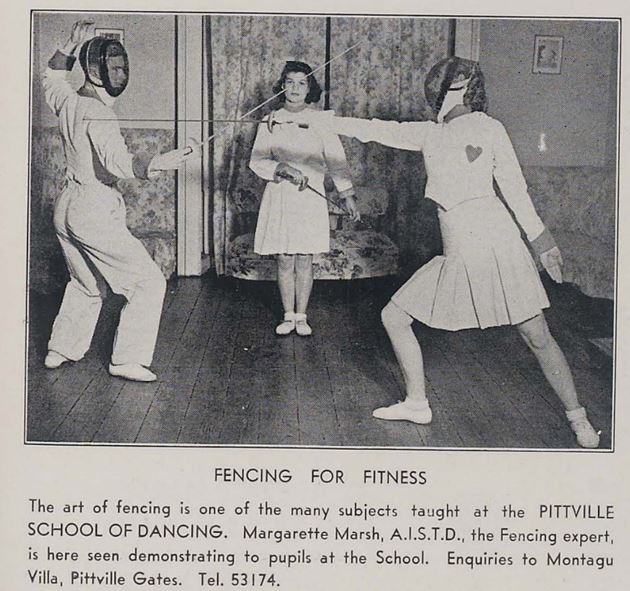
A fencing lesson at the Pittville School of Dancing
The Cheltenham Chronicle and Gloucester Graphic
The school Principals were Frank and Janet Lister. They were both active in the local area, with Frank (also a fine golfer) adjudicating at local competitions, often held as wartime fundraisers for charities such as the Dancers’ Victory Fund or the Cheltenham Victory Fund. The Listers organised festive occasions such as the New Year’s Eve Winchcombe Hospital Ball. Guests would be treated to demonstrations of ballroom-dancing by the Listers and other experts. The school was still advertising in December 1950.
For further information of educational establishments in Pittville, see our article ‘Education in Pittville: Preparatory Schools in Pittville Circus Road’, by Mark Penfold. Further research may well uncover more, and although most of the schools no longer exist, former teachers and pupils of the more recent establishments share memories in local history projects and on sites such as Days Gone By. While some schools were short-lived, some thrived for several decades, and all formed part of the tradition of private education which still remains strong in Cheltenham.
Sandy Marshall
with contributions from John Simpson and Mitchell Brown
* Barbara King, PGSG: A history 1905-1946 Cheltenham’s Other Girls’ School (1990)